
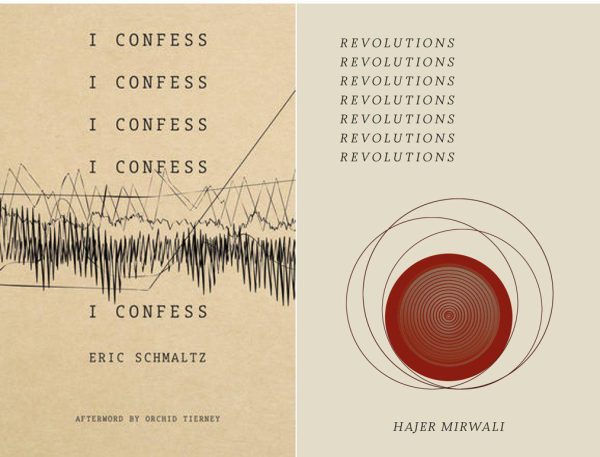
Something poetry continually teaches us: language conceals as much as it reveals. Where the lyric poem works to conjure a unique and specific consciousness, the conceptual poem is often a cheeky kid dancing around an effigy of this absurd and mythical “I”. In two recent, exciting texts, we get both performances at once. Eric Schmaltz’s I Confess (Coach House, 2025) and Hajer Mirwali’s Revolutions (Talonbooks, 2025), offer the promise of revelation and the certainty of obfuscation, probing the ways that language simultaneously creates and elides truth.
Where the lyric poem works to conjure a unique and specific consciousness, the conceptual poem is often a cheeky kid dancing around an effigy of this absurd and mythical “I”.
I Confess is structured around the poet’s experience subjecting himself to a polygraph test, and the collection includes transcripts and photographs from the session. The collection begins with the statement: “This book is a document of truth’s performance under duress. Some of what you will read is true; the rest is poetry.” From the outset, Schmaltz invites us to consider our expectations of poetry, and of communication more broadly; the collection continually reminds us that truth is something that we perform, and that it shifts depending on what compels the performance.
Schmaltz’s collection begins with a series of poems chronicling various examples of “truth under duress”: “Trial by Combat”; “Trial by Fire”; “Trial by Waterboard,” and others, including “Trial by Voice,” a transcript of the statement beginning the polygraph test (“I am here of my own free will…”) above the sonograph reading. The poem begins: “Truth peaks while lies plateau. Analyze the following sonographs to determine the poem’s truth-speak” (26). The gamified invitation reminds us of the fallibility of the mediums – polygraph and poem – in their transmission of “truth”; nonetheless, it is intriguing that the phrase “own free will” tapers like a mascara wand, the sonograph line noticeably lower than other areas. “Coercion” goes flat, too. On the collection’s first page, “Free will” is a redacted phrase.
Schmaltz interrogates the autonomous self not only in the polygraph transcripts but also in a triptych of poems that follow the question “How would you describe yourself” (beautifully, the photograph of the poet here is just his bent arm, as he rises from the chair). The poems make it clear immediately that we are not in the realm of autobiography: “I was born / was born & raised / born & grew up / I am the youngest child / the eldest / the middle child / I am the only girl amongst five brothers / the only boy among four girls…” (79). Even the stutter of the first phrases places us within a kind of nested storytelling, a multiplicity of tales. The poem’s third section uses phrases from obituaries to create a patchwork elegy: “a celebration of life will be held / friends and family will be received / many thanks will be given / expressions of sympathy will be made…” (81). Despite the ironic distance created by the passive voice and the pat phrases, the poem, in aggregate, is deeply moving.
Throughout I Confess, Schmaltz teases and denies our desire for access to another’s interiority; even so, the collection yields a sense of immediacy, interconnectedness, and intimacy. It is, to use a phrase the text plays with, a performative utterance: its texts make something happen, bring something new into being.
So too does Hajer Mirwali’s innovative collection, another formally experimental exploration of the concept of the self as poetic subject. Like I Confess, Revolutions uses typography as a mode of revelation and concealment as it works through the role of language in self-creation and in our dis/connections to family and community.
Mirwali’s work is also structured around an experience – in this case, an encounter with an artwork: Mona Hatoum’s + and – , a framed box of sand with a motor at the centre continually creating and erasing circular grooves. The sculpture frames several of the collection’s themes, most notably repetition and difference, mothers and daughters, and time. In “January 22,” a poem that begins with the poet’s birth and the creation of + and – (both in 1994), Mirwali writes: “Grains of sand flowing through one / another. Every daughter grain resorbs her / mother grain as first foreign body. Lives her / whole life with that inside her.” As in I Confess, the poetic subject here is apodictically unique and specific, and at the same time multiple, mutable, slippery as sand.
While both collections use redacted text, in Mirwali’s the obfuscated language at times has a pointed purpose – to protect those she is writing about. The collection yields intimate portraits of young Arab women as they enact versions of selves and womanhood that are both true to their desires and permissible within restrictive communities. Throughout the collection, she moves between English and Arabic, “following the Arabic Texting Code” (114); the word for “shameful,” which appears often, is “3aib.” The second poem by this name, which comprises the section “Revolutions,” begins with a page on which the words “3aib,” “and,” and “xxxxxxx” scatter and cluster, a record of possibility and prohibition (100). The poem moves into a more lyrical mode, but one still based in concealment – “I have been sitting in the sand with xxxxxxx”; “It is not within xxxxxxx to hide / It is within xxxxxxx to hide and every day / the lies breed more lies” (101). Mirwali’s language inscribes and erases desires that must not, for this speaker and her community, be spoken aloud. Formal innovation here is a necessity, a search for form to convey selves that would otherwise be inarticulable.
Throughout the collection, she moves between English and Arabic, “following the Arabic Texting Code” (114); the word for “shameful,” which appears often, is “3aib.”
Both texts suggest that, despite our elisions and excisions, we are deeply connected to each other, despite all we cannot say.
Eric Schmaltz is the author of Borderblur Poetics: Intermedia and Avant-gardism in Canada, 1963–1988 (University of Calgary Press) and Surfaces (Invisible Publishing), editor of Another Order: Selected Works of Judith Copithorne (Talonbooks), and co-editor of I Want to Tell You Love by bill bissett and Milton Acorn. His creative work has been published, exhibited, and performed nationally and internationally.
Hajer Mirwali is a Palestinian and Iraqi writer living in Toronto. She has an MFA in Creative Writing from the University of Guelph. Her work has been published in the Ex-Puritan, Brick, Room, and Joyland.
I Confess:
Publisher: Coach House Books (September 9, 2025)
Paperback 5.5″ x 8.5″ | 112 pages
ISBN: 9781552455111
Revolutions:
Publisher: Talonbooks (May 6, 2025)
Paperback 8″ x 9″ | 113 pages
ISBN: 9781772016505

Samantha Annie Bernstein is the author of Here We Are Among the Living, Spit on the Devil and Kitchen Island Poems. Her writing has most recently appeared in Toronto Journal, Pinhole Poetry, and Canadian Theatre Review. She is an adjunct professor of English and Creative Writing at York University.

